Wednesday, July 14, 2010

While I have your attention

First of all: Sorry about the picture. That's what I get for being lazy and using a link instead of uploading pictures. The pictures change. There's some complicated computer explanation with remote servers and hotlinks and other words that I don't quite understand so, I'll say this: It was not on purpose an I'm sorry for those of you whose minds have been scarred.

And NOW, because you're waiting to hear about my school, I'll take advantage of the situation. This post contains all of the thoughts I've had or things I've noticed that don't have enough substance to actually turn into a blog post, but that I think are still interesting. There is no particular order or progression at all, it is merely what comes to my mind.

I do not know how the Japanese:
cut things with chopsticks
don't make a mess when eating noodles with sauce on them
put their lace-up shoes on so quickly
avoid being smelly and sweaty in a country where A/C is a surprise

Sensei is always talking about how the Japanese do nothing but study and school is really important, but I haven't talked to a kid yet who didn't fail at least one of their tests this semester.

On the same note, my International English class is not very good at speaking English.

There are some sounds that the Japanese just cannot make; the a sound in 'banana,' 'fan' is one of them.

I didn't know how all of the girls here are so skinny, because food is abundant and their P.E. classes are a joke.

I later found out why everyone is so skinny; I think I'm the only person in this country who isn't on a diet.

I think I've discovered why the girls here are so girly. If they weren't they would be confused as guys, because guys in Japan are so feminine. Sometimes on the bus or the subway I like to play a fun game called 'Guess the Gender.' In the past few days I have seen three people that had, and still have me completely stumped.

GUESS THE GENDER (answers are at the bottom)
It's a little hard to sneak pictures of people on subways and in public, so these are all just off of the interent, and they are the most androgynous of the androgyny.


ANSWER: They're all men. I admit the guy in the skirt is a bit much, but you get the picture.

There are drink vending machines all around Japan, but I haven't seen one that sells food the whole time I've been here.

The Japanese can handle 106 degree baths every day, but when it comes to weather and food they can't handle hot to save their lives.

Everyone is very serous about their job, even if it is just being a cashier or a janitor.

When Japanese people do construction work they put up screens or walls, and they clean up their mess when they are done. The same goes for city maintenance.

In America, we expect visiting foreigners to speak English. in Japan, they are surprised when visiting foreigners can speak Japanese.

Driving in Japan is almost indescribable. People break the rules, but there are rules for the rules to break, and everyone allows everyone else to break the rules. For example, even if the light is red, a couple of people can turn left if they are waiting in the left turn lane. Also, scooters and motorcycles and the like weave in and out of traffic like no one's business, and instead of cursing them like we do in America, it's completely accepted. If you want to get somewhere faster, you travel by scooter or some other motorized, two-wheeled vehicle.

Cars in Japan are amazing colors.
It's also difficult to take pictures of moving vehicles while you're moving, so once again all of these pictures are from the internet.


I have seen every single one of these colors, and more. They are not uncommon. My host family has a pink car, and I would wager that pink is one of the most common car colors in Japan.

That's all for now, but I'll add things as I think of them.

Tuesday, July 13, 2010

Sorry...

I haven't been writing much lately, but I've been amazingly busy since school started Friday. I went to a party on Sunday and didn't get home until 7:30. Yesterday I tried out Badminton Club, which was surprisingly fun, and didn't get home until 7:00 when I ate dinner, took a shower, and went to bed. So I apologize, and I will have a gigantic blog post ready on Friday about everything that I'm doing in school. So, hang tight and be prepared to have your socks knocked off by this next one (although if you expect too much it won't be any good...).

Friday, July 9, 2010

First day of school!

Yesterday was my first day of school. I don't think I have ever been more tired at the end of a school day. I heard the word 'かわいい' as many times in my life, combined as I heard it yesterday. It is still ringing in my ears. I also taught a girl the words 'hot boy' when she asked what イケメン meant. Later when she introduced herself in English class, she said she liked hot boys. Some other American things Japanese teenagers like: 'Prison Break,' 'Lost,' Green Day, Taylor Swift, and Justin Bieber.
It may just be my school school that likes those things, but I don't think so. But my school is not an ordinary school. First of all, it's a private school. It has different advanced classes and basic classes, and the advanced classes are divided up into subjects. For example, I'm in the International English class, even though only one of the kids is very good at speaking English; he's the head of the English club. We don't change from shoes to slippers when we enter the building, the school is air conditioned, and it looks less like a prison and more like a hotel.
Normal Japanese high school:


Chukyo High School:

And did I mention that they are the reigning champion of the national high school baseball tournament? And that they have produced several world class figure skaters, including Mao Asada, the 2010 silver medalist? I'm two years too late to have met her though. If I had met her, I probably wouldn't remember her name, just like the rest of the kids in my class.

The kids I remember from class 2-I, out of 32, are very few in number.
First, there's 'Imaidon' (his real name is just Imai), also labeled in my head as Oguri Shun. There's also Oguri Shun's friend, but I only only know his name because I have a seating Chart.
There's Maya, the really nice girl who sits on my right and has an electric dictionary to translate ridiculous kanji for me.
On my left... well, I don't know her name, but she's really nice and chats with Oguri Shun, his friend, and Kuma.
There are three Harukas in my class, and one goes by Kuma (part of her last name). Her and I are working on an English project together.
Mirei is very sweet and very tall and thin.
There's also Tennis Club Girl and there's Cheer Leading Girl, also known as the Girl Who Likes Hot Boys.
There's the Funny Girl With The Round Face, whose name I now know thanks to the seating chart.
Last but not least, there's Yuri Abe, also known as Abe-chan, Yu-chan, Yuri, Abe, Yuri-chan... basically any combination of her name and 'chan' that you can come up with. She is also really funny.
There's also English Club Boy, the Boy Who Sits Behind Me, and the Girl From 2L, but I don't know their names either.

After coming home from my first day of school I passed out for two hours, almost missed dinner, and was in bed by 8:30. Needless to say, it was a good day.

I didn't get many pictures on my first day because I was a little overwhelmed, but I'll try to take some more on Monday. Maybe I'll know everybody's names by then! Probably not though.

Thursday, July 8, 2010

I'm Turning Japanese

My only plan for today was karaoke with my host sister and Mary, another YFU student who lives close to me in Nagoya, but it ended up being so much more. Mary called last night during my host sister's and my tacos party (during which I realized I am the only girl in this country who does not have a very cute boyfriend, husband, fiance, or some other variation of a significant other) and we planned for my host sister an I to meet her at a subway station at 11 AM. Isn't 11 AM a little early for karaoke? It turns out that no, we could have met up earlier and been able to fill the time.

First we had a surprise visit to the mall. My experience with malls in Japan has been pretty boring; the mall near my house is a sleepy, three story mall (one story is a grocery store), where the liveliest shop is the frozen yogurt/tea shop. This mall was more of what I am used to. After a little bit of shopping and topping off my souvenirs for everybody back home we had lunch at a Chinese restaurant. The dumplings were delicious, and my 'dangerously spicy' tofu was neither of the things it promised it was.
There were a lot of things in this mall that I was not used to, including this guy, who appears to be in the deodorant biz,

crane machines with food inside of them,

and, last and best of all, purikura. The photo booths are the best machines ever invented. You step into them and it's probably four times the size of a Western photo booth, with four or five huge, glowing white lights. The inside is totally green, presumably so that you can use all of the effects. You put 400 Yen into the coin slot, and you pick a little scene or background to take your photo in (three at a time). There are various backgrounds for two or three people, plain patterns, specific poses, basically everything that you can imagine. After taking six unique photos, you go outside to a screen where you can decorate the pictures with cute designs and various pens and, once again, basically everything you can imagine. When you're finished with that part (and the purikura machine has successfully made everyone's eyes gigantic and a little creepy, if you're not Japanese) you have the choice to send to pictures to a cell phone. Finally, after all of that, you get the photo arrangement you chose and can then go cut them up however you like... and they're stickers! Why we don't have purikura in America I don't know, but it needs to be fixed, pronto. Here are a couple of examples:


Purikura was the first amazing Japanese thing that I discovered today. The second was karaoke. The karaoke place that we went to looked more like a hotel lobby or a restaurant at first, complete with a drink bar and menus for both food and karaoke. There were so many options to choose from!

The karaoke room we chose could have held about eight more people, and it had one of the low tables, cushions to sit on, and a well beneath the table to put your feet in. They even had slippers for the customers, but they were about four sizes to small for any of us, even my Japanese host sister.

The videos that played during the songs were hilarious. They were cheaply made and looked like they were made in the 90's (which was perfect for when we sang Backstreet Boys and Britney Spears songs). During 'Hakuna Matata' there were kittens playing for about half of the song.

We spent about four hours at karaoke, but it felt like half of that time. Saeko and I got home just in time for dinner (tonight was sushi) and after dinner I watched ARASHI on some weird game show. The three events that I saw (I didn't see the whole show) were Jungle Bingo, Rolling Coin Tower, Pinball Runner, and a jenga-esque game with a giant robot that I don't remember the name of. In Jungle Bingo, each team had to climb through a jungle gym/maze and open a bingo square when they reached the top, and only two could go at a time. Winner: Jokers (not ARASHI). In rolling coin tower Matsujun, Nino, and two players from the other team took turns stacking big face coins on top of each other as the tower passed by them on a circular conveyor belt. Winner: ARASHI. In Pinball Runner one person had a huge basket strapped to them and they had to run on a conveyor belt to catch balls in their basket, but they couldn't see the balls ahead of time. Instead they had to rely on two team members tell them where the balls would be coming from (there were numbers along the wall to make it easier). Winner: Jokers. Last, there was a giant robot on blocks, and each team removed three blocks per turn. When the robot fell, whichever team removed the last block lost. Winner: Jokers. Finally at the end, since ARASHI lost, everyone was standing on platforms above foam pits and they chose one person to drop into the foam pits. Too bad, Aiba.

In related news, ARASHI released a new single yesterday, 'To Be Free.'

Link: Arashi- To be Free PV

Tuesday, July 6, 2010

Kyoto, Revisited

The second day we were in Kyoto we had a leisurely morning; no early trains or hauling luggage around. We woke up and watched a replay of the Spain-Paraguay match while we ate our breakfast in a cute little dining room with another exchange student and her visiting family. They were from Boston and she had just finished a seven month home stay with another program, and it turned out the her and Adena have several mutual friends. Small world.
This was also the first, and last, morning that I ate a Japanese breakfast. I cannot handle fish, miso, some odd substance that looked like tofu but tasted fishier than tofu, before about noon. Also, I can't operate a pair of chopsticks that early in the day. Now that I've tried it I am justified in saying that I prefer Western-style breakfast. I have great respect for those people who can consume fermented soybean soup with two thin, wooden sticks for breakfast, but I will stick to cereal and fruit with a spoon and fork. Please and thank you.

After breakfast we boarded a train bound for Arashiyama, (which means storm mountain, but which is also just the mountain's name), and I was a little disappointed when I got there. I was expecting a rugged mountain worthy of the name Arashiyama, with deep gorges that had taken peoples' lives and untamed, foreboding forests. Instead, it was a sleepy town full of souvenir shops with a pretty river running through it and mountains surrounding it.

Me Adena, and Haruka sitting by the river, glistening with sweat from the walk from the station. Also take note of the gangsta peace sign.
I don't mean to say that it wasn't a nice town, because it was. It smelled good and had a uniquely Japanese feel about it, but I expected to see more 'Danger: Cliff' signs and fewer signs outlawing business transactions.

Little did I know that there was more to come. After souvenir shopping for a little bit and basking in air conditioning, we stumbled upon (I think it was planned and I was just unaware) a busy path winding up into the forest and up the mountain. This is more what I thought Arashiyama would be like.
I think this is a graveyard, but there's no real reasoning behind that assumption. A graveyard is a lot cooler than anything else that this would be, so I'm just hoping.
The path wound its way through a bamboo forest the whole way up the mountain. The backyard bamboo we have in Texas can barely be called bamboo in comparison to this forest. The biggest bamboo were probably six inches in diameter, give or take a little, and the smallest were about the size of my neck. There was no end to the forest in sight on either side of the path, and practically no sky peeked out from between the glowing green canopy of bamboo.
There were gift shops and temples and shrines nestled here and there in the bamboo, and we stopped by one of each.
The shrine we saw was right next to a little pond where the wind was blowing everything everywhere.
In this picture you can see the torii, the little gate things with the ropes on them, and in the background you can see the bell that people ring to get the attention of the gods before they clap their hands twice and pray. The wooden plaques hanging up are called ema. You can buy these plaques at a shrine, write your wish on it, and hang it up with all of the others and your wish will be granted.
Here there is a guardian (I think) and the place where you wash your hands and mouth to purify yourself before you pray at the shrine. Most of the shrines I've been to have had lost of ladles and huge basins where you can wash your hands (first left, then right) and mouth (after your hands), but this one was tiny.

After that we stopped at a gift shop and waited for a sightseeing train to arrive. I was imagining a dinky little train like the one in Zilker Park, but this was a legitimate train. It was called the Sagano Romantic Train, but most of the passengers were parents with children and other tourists. It was not what would call 'romantic.' The view from the train was amazing though. I felt like I had gone through a time warp (and a reality warp) and ended up in Middle Earth...
...except for the huge telephone/electricity line in the background.
I had seen Tanuki here and there in front of shops and restaurants, but never before have I seen so many terrifying Japanese raccoon dogs in one place, or so neatly organized.

The Japanese is both a real creature, and a mischievous and wily character in Japanese folklore. The really creepy statues are usually wearing these hats, carrying a bottle of sake in one hand, and a promissory note or empty purse in the other in the other, and they always have huge stomachs and 'humorously large' testicles based on biological fact. Why would you want one of these things in front of your shop?
Luckily, there was more scenery to wash that image out of my head.

I think the picture is too small, but in the bottom corner there are two people kayaking those rapids. I realized later why there were so many kayakers. In the middle of tens of rice paddies, there was a place that rented out kayaks and had little kayak outings.


I was more focused on the rice paddies. They're so cool! On the way back to the station we ran into an enormous tanabata decoration. There were bamboo archways on either end and the sides were lined with bamboo weighed down with countless strips of paper.


Tanabata is a festival on July 7th (7/7), and the story behind it is that this is he only day that a prince and a princess can meet because of something to do with the milky way.
We visited a museum too, but it wasn't very exciting. I say several of Van Gogh's original 'Water Lilies' but we were rushed for time so I wasn't able to properly admire them.
The train ride back to Nagoya on the shinkansen was about 35 minutes, compared to the two hours it took us on a regular train. Why are the Japanese so great at inventing stuff, and why do we not get any of their technology?

Saturday, July 3, 2010

Kyoto day 1

Thank you, General Douglas MacArthur and Secretary of War Henry Lewis Stimson. Were it not for them, Kyoto and its 1600 Buddhist temples, 400 Shinto shrines, and its 14 "Historic Monuments of Ancient Kyoto" that have been designated a UNESCO World Heritage site would have been destroyed in a fashion similar to that of Hiroshima or Nagasaki.
Hiroshima before and after Little Boy was dropped on the city.

If I ever meet any relatives of those men, I will hug them. Kyoto is an amazing city. After arriving in Kyoto Station after about two hours on a regular train, our itinerary was as follows:
Day 1:
Sanjusangendo (三十三間堂/さんじゅうさんげんどう) 33 Gen Hall
Kiyomizu-dera (清水寺/きよみずでら) Kiyomizu Temple
Kinkakuji (金閣寺/きんかくじ) Temple of the Golden Pavilion
Instead of presenting things in chronological order, I'm going to save the best for last.
I, Adena (a fellow YFU student), Haruka (Adena's host sister who is out of college), and Haruka's friend Hiromi, had a busy day ahead of us.

By the time we got to Kinkakuji after about thirty minutes on a bus, we had only ten minutes until the temple closed and it was pouring down rain. Since the weather was so horrible and we were running so low on time there weren't many other visitors there to get in the way. Needless to say, the temple was very golden.

Compared to the other temples I have been to, in both Nagoya and Kyoto, it didn't really feel much like a temple. In fact, it was originally built as a retirement villa for Shogun Ashikaga Yoshimitsu in the late 1300s and converted into a temple by his son, Shogun Ashikaga Yoshimochi.
Later, in 1950, the original temple was burned down when a monk named Hayashi Yoken attempted suicide. The temple was rebuilt in 195, and in 1984 the lacquer on the Temple was found to be decaying. In 1987 the new coats of thicker and more robust paint and gold leaf were completed.
On the top you can see the phoenix roof ornament. I don't think there's any significance, I think it's just a phoenix on the roof.
A few statues that I think are Jizo, the protectors of travelers and children.
The temple was beautiful, but it did not have the same feeling about it that the other temples possessed. Maybe it was because the latest renovation, a new roof, was completed in 2003, or maybe it was because you couldn't actually enter the temple, but it felt more like an artwork being displayed than a temple. It was an extremely beautiful piece of art though.

Before going to Kinkakuji, we spent most of our day at Kiyomizu-dera. Kiyomizu-dera is a Buddhist temple that dates back to 798, but the current structures were built in a reconstruction effort in 1633. Not one nail was used to build the temple complex, and the name kiyomizu, meaning clear or pure water, comes from the waterfall that runs off in the nearby hills. The three tiered pagoda at Kiyomizu-dera.
The waterfall runs out of the mountains into this little fountain, where people wait in line to drink from the spouts.
There are three spouts, and there are sanitized cups with which you can reach out and drink for health, longevity or wisdom. Traditionally, you should only drink from tw of the waterfalls because if you are greedy and drink from all three it will bring misfortune upon you. I only drank from one, and I think it was the health waterfall, but I'm not sure. I'm okay with longevity or wisdom, too.
Fun fact about Kiyomizu-dera: There is a phrase "to jump off the stage at Kiyomizu." This phrase refers to an Edo Period tradition of jumping the 13 meters off of the stage at Kiyomizu-dera, and if you survived the jump your wishes would be granted. Out of 235, 85.4% of the jumps were "successful," meaning the jumper didn't die. Injuries are another matter. Now, jumping off the stage at Kiyomizu is strictly forbidden.
On the right you can see just how big a fall it would be, and in the middle you can see Kyoto on the horizon and Kyoto Tower sticking up out of the city.

Behind the main hall of Kiyomizu are several other shrines, but the most popular and famous of them all is Jishu Shrine, dedicated to the god of love and 'good matches.' There were all sorts of love omamori for sale and omikuji for sale. Omikuji are little sheets of paper that usually cause one or two hundred yen. There are various fortunes you can get, ranging from the best, more good than bad, the worst, and everywhere in between. Inside the omikuji are various and more specific fortunes pertaining to love, money, lawsuits, lost items, etc., all based on the overall luck of the omikuji. When you get a bad fortune you can tie it to a post and the bad luck will leave you. Hiromi tying up her bad-luck omikuji.
Omikuji are at every shrine that I have been to, but these stones are unique to Jishu Shrine.

If you walk safely between them with your eyes closed, you will find your true love. You can have someone help you, but that means that you will have to have a go between to find your true love. Both Adena and I made the journey successfully! But... we both helped each other out. They need to include that part on the sign explaining the meaning of the stones.

Before going to Kiyomizu-dera, we visited Sanjusangendo, which translates literally to the Thirty Three Gen Hall*. This temple was built in 1164, but the main hall was rebuilt in 1266 after it was damaged in a fire.
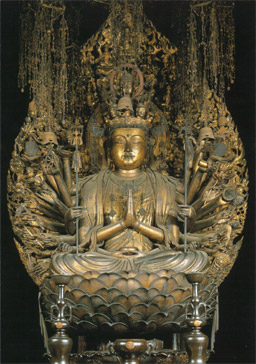
Inside this approximately 65-meter-long hallway, there are one thousand golden, armed Kannon (similar to Buddha) statues**. 124 of these statues are from the original temple, and the other 876 statues were rebuilt at the same time the hall was rebuilt. It is said that each of the statues has a different face so that you can find the face of the person you are praying for, but I couldn't see more than about five different faces in amongst the thousand statues.
In the temple you weren't allowed to take any pictures of the sacred statues, but there still seem to be pictures floating around of the statues.

A picture can only convey so much. Inside this temple there is a spooky feeling hanging in the air. I can't describe it, except that it made the air feel really heavy. I felt like if I wasn't careful, I would wake up something powerful and terrifying that had been asleep for hundreds of years. With all of the statues in the hall, and even though they all had their eyes closed, it feel like something was watching you as you walked down the hall. It was extremely unsettling, but at the same time really really cool. In addition to the one thousand armed Kannon in the temple there is one large Kannon in the canter of it all. At one point it must have been golden, but now it is fading and dusty and worn, but that just makes it all the more enthralling.

In front of the ranks of Kannon are 28 guardian deities, the most famous and important being the statues of the thunder god Raijin and the wind god Fujin. Not only are the Kannon a National Treasure, but each of the 28 statues of the guardian deities is a National Treasure.
I could have stayed in that hall all day, but no on else seem as fascinated by it as I was, so we left for Kiyomizu-dera before I even had time to read all of the signs about the guardian deities. But I got an omamori that's supposed to make me have better luck, something I am greatly lacking.

After a day full of sightseeing and building up my good luck we went out to eat dinner at a Japanese-Italian fusion type restaurant. I decided to be adventurous, and I unknowingly ordered pasta with fish eggs on it. It turns out that fish eggs don't actually taste like much, and now I can say I've eaten fish eggs.

After dinner we checked into a ryokan, a Japanese inn. Two rooms were reserved, one Western-style room and one Japanese room. Adena, the other YFU student I was traveling with, and I were in the Western-style room. I wanted the Japanese room, but I figured that since Haruka and Hiromi has just taken us around Kyoto, I was going to do whatever they told me too because they had done so much for us. Luckily for me, Haruka decided that since they were in charge of us, we should split up with one adult to a room and one YFU kid. It appears that my good luck charm is working already.

The hotel room was adorable, complete with tatami mats, futons with amazingly fluffy bedding, yukata (way better that the Tokyo Disney Yukata), and a low-to-the-ground table with chairs that made your feet fall asleep.
Hiromi was adorable too. While watching the Wimbledon women's finals, she commented the Zvonareva was really pretty. After that I pointed out Zvonareva's coach, and for the next thirty minutes she waited for him to appear on screen again so that she could take a picture of him with her phone. There's a reason he modeled in Italy. After watching Zvonareva lose, we watched a Japanese girl lose too and decided it was time for bed.


*A ken is an ancient Japanese measurement. There is no specific length of a ken. Instead, it refers to the space between the columns of a temple.

**The statues are made of Japanese cypress and painted golden.

Thursday, July 1, 2010

Arakogawa Kouen (Arakogawa Park)

Yesterday I went to the Aichi Arts Center and saw an amazing exhibit of some traditional Japanese silk paintings, but there was no photography allowed. And the woman at the ticket booth made me pay full price because she didn't believe I was a high school student. What a b----. But if you want to see some amazing paintings Google Watanabe Kazan, or for some really vivid woodblock prints look up Kawase Hasui.

Most of the pieces in the exhibit were of nature, and if not nature, they ere portraits. It seems that everything in Japan is full of and surrounded by nature. Even here in Nagoya, a port city that earned 70% of Japan's trade surplus in 2003 and whose automotive industry is comparable to Detroit, there are trees and parks everywhere you turn. When I walk out of my house I can see a park down the road, and there is another park about a mile away. These parks aren't the playground kind of park either (although they have those too), these parks have things like traditional Japanese gardens and castles in them.

Arakogawa Kouen is about a mile away from house. The journey to the park isn't exactly the most scenic route, but it's interesting.

My house (the kanji by the mailbox reads 'Itani') My entire family loves gardening, so there are flowers and plants everywhere. My host dad even has a farm alittle ways away where he grow potatoes, onions, bitter melon, and everything else that you could possibly imagine. We eat a lot of vegetables for dinner.

The neighbors: one side is a parking lot, in front of the house is some sort of industrial building that is always unloading or loading something from a huge truck and a lady speaks a lot over the intercom, and on the other side we have these:

The pachinko place and the baby store right by my house. I feel like these two buildings shouldn't be right next to each other, but I guess this way they don't have to compete for customers. I hope.
The streets in Japan (if they're not major) are so narrow that two cars could not fit together side by side. It's a good thing that the cars in Japan are small, or I, and anyone else, who walked on the side of the road when there wasn't a sidewalk would be dead. Also, the streets here do't have names, certain areas have names, and in those areas are different blocks. It is really confusing.

Weird cartoon characters on the kindergarten wall. I think I'm actually watching this cartoon right now.

A sign for Arakogawa Park Garden Plaza. There's a fork in the path at one point where one way will lead you back to the road that crosses over the park, and the other way will lead you into a traditional Japanese garden that is absolutely amazing. I think that's the garden plaza, but I'm not positive because there are flowers and gardens everywhere in the park.

The trees hanging over the path all have cherry blossoms on them in the spring. I can't even imagine what that would look like.

The picture isn't great because my camera isn't great, but these are all lavender plants. the Japanese are really into their foliage, and right now it's all about lavender and 'ajisai,' or hydrangeas. The only downfall of this area of the park is that there are enormous bees attracted t all of the plants.

Bridge over Arakogawa (Arako River). there are four or five bridges, but this is the only bridge that's really elevated so that you can see a lot. Also, it seems that all of the bridges in Japan have the same design on the railings. The vertical poles of the railing are twisted ninety degrees so that there's a wave pattern in the railing.

Bridge and Arakogawa from another bridge. The first time I ran across this bridge I had a terrible urge to jump in the river. That urge quickly passed when I saw two enormous fish swimming by. There are birds that like to sun themselves on the trash barrier, turtles that pop up every now and then, ducks that swim around, and huge fish that swim around. Every day there are at least two old Japanese men who have parked their bikes and are fishing off the edge of the river.
There's also a group of old people playing croquet every day and it is absolutely adorable.