Showing posts with label Kyoto. Show all posts

Tuesday, July 6, 2010

Kyoto, Revisited

The second day we were in Kyoto we had a leisurely morning; no early trains or hauling luggage around. We woke up and watched a replay of the Spain-Paraguay match while we ate our breakfast in a cute little dining room with another exchange student and her visiting family. They were from Boston and she had just finished a seven month home stay with another program, and it turned out the her and Adena have several mutual friends. Small world.
This was also the first, and last, morning that I ate a Japanese breakfast. I cannot handle fish, miso, some odd substance that looked like tofu but tasted fishier than tofu, before about noon. Also, I can't operate a pair of chopsticks that early in the day. Now that I've tried it I am justified in saying that I prefer Western-style breakfast. I have great respect for those people who can consume fermented soybean soup with two thin, wooden sticks for breakfast, but I will stick to cereal and fruit with a spoon and fork. Please and thank you.

After breakfast we boarded a train bound for Arashiyama, (which means storm mountain, but which is also just the mountain's name), and I was a little disappointed when I got there. I was expecting a rugged mountain worthy of the name Arashiyama, with deep gorges that had taken peoples' lives and untamed, foreboding forests. Instead, it was a sleepy town full of souvenir shops with a pretty river running through it and mountains surrounding it.

Me Adena, and Haruka sitting by the river, glistening with sweat from the walk from the station. Also take note of the gangsta peace sign.
I don't mean to say that it wasn't a nice town, because it was. It smelled good and had a uniquely Japanese feel about it, but I expected to see more 'Danger: Cliff' signs and fewer signs outlawing business transactions.

Little did I know that there was more to come. After souvenir shopping for a little bit and basking in air conditioning, we stumbled upon (I think it was planned and I was just unaware) a busy path winding up into the forest and up the mountain. This is more what I thought Arashiyama would be like.
I think this is a graveyard, but there's no real reasoning behind that assumption. A graveyard is a lot cooler than anything else that this would be, so I'm just hoping.
The path wound its way through a bamboo forest the whole way up the mountain. The backyard bamboo we have in Texas can barely be called bamboo in comparison to this forest. The biggest bamboo were probably six inches in diameter, give or take a little, and the smallest were about the size of my neck. There was no end to the forest in sight on either side of the path, and practically no sky peeked out from between the glowing green canopy of bamboo.
There were gift shops and temples and shrines nestled here and there in the bamboo, and we stopped by one of each.
The shrine we saw was right next to a little pond where the wind was blowing everything everywhere.
In this picture you can see the torii, the little gate things with the ropes on them, and in the background you can see the bell that people ring to get the attention of the gods before they clap their hands twice and pray. The wooden plaques hanging up are called ema. You can buy these plaques at a shrine, write your wish on it, and hang it up with all of the others and your wish will be granted.
Here there is a guardian (I think) and the place where you wash your hands and mouth to purify yourself before you pray at the shrine. Most of the shrines I've been to have had lost of ladles and huge basins where you can wash your hands (first left, then right) and mouth (after your hands), but this one was tiny.

After that we stopped at a gift shop and waited for a sightseeing train to arrive. I was imagining a dinky little train like the one in Zilker Park, but this was a legitimate train. It was called the Sagano Romantic Train, but most of the passengers were parents with children and other tourists. It was not what would call 'romantic.' The view from the train was amazing though. I felt like I had gone through a time warp (and a reality warp) and ended up in Middle Earth...
...except for the huge telephone/electricity line in the background.
I had seen Tanuki here and there in front of shops and restaurants, but never before have I seen so many terrifying Japanese raccoon dogs in one place, or so neatly organized.

The Japanese is both a real creature, and a mischievous and wily character in Japanese folklore. The really creepy statues are usually wearing these hats, carrying a bottle of sake in one hand, and a promissory note or empty purse in the other in the other, and they always have huge stomachs and 'humorously large' testicles based on biological fact. Why would you want one of these things in front of your shop?
Luckily, there was more scenery to wash that image out of my head.

I think the picture is too small, but in the bottom corner there are two people kayaking those rapids. I realized later why there were so many kayakers. In the middle of tens of rice paddies, there was a place that rented out kayaks and had little kayak outings.


I was more focused on the rice paddies. They're so cool! On the way back to the station we ran into an enormous tanabata decoration. There were bamboo archways on either end and the sides were lined with bamboo weighed down with countless strips of paper.


Tanabata is a festival on July 7th (7/7), and the story behind it is that this is he only day that a prince and a princess can meet because of something to do with the milky way.
We visited a museum too, but it wasn't very exciting. I say several of Van Gogh's original 'Water Lilies' but we were rushed for time so I wasn't able to properly admire them.
The train ride back to Nagoya on the shinkansen was about 35 minutes, compared to the two hours it took us on a regular train. Why are the Japanese so great at inventing stuff, and why do we not get any of their technology?

Saturday, July 3, 2010

Kyoto day 1

Thank you, General Douglas MacArthur and Secretary of War Henry Lewis Stimson. Were it not for them, Kyoto and its 1600 Buddhist temples, 400 Shinto shrines, and its 14 "Historic Monuments of Ancient Kyoto" that have been designated a UNESCO World Heritage site would have been destroyed in a fashion similar to that of Hiroshima or Nagasaki.
Hiroshima before and after Little Boy was dropped on the city.

If I ever meet any relatives of those men, I will hug them. Kyoto is an amazing city. After arriving in Kyoto Station after about two hours on a regular train, our itinerary was as follows:
Day 1:
Sanjusangendo (三十三間堂/さんじゅうさんげんどう) 33 Gen Hall
Kiyomizu-dera (清水寺/きよみずでら) Kiyomizu Temple
Kinkakuji (金閣寺/きんかくじ) Temple of the Golden Pavilion
Instead of presenting things in chronological order, I'm going to save the best for last.
I, Adena (a fellow YFU student), Haruka (Adena's host sister who is out of college), and Haruka's friend Hiromi, had a busy day ahead of us.

By the time we got to Kinkakuji after about thirty minutes on a bus, we had only ten minutes until the temple closed and it was pouring down rain. Since the weather was so horrible and we were running so low on time there weren't many other visitors there to get in the way. Needless to say, the temple was very golden.

Compared to the other temples I have been to, in both Nagoya and Kyoto, it didn't really feel much like a temple. In fact, it was originally built as a retirement villa for Shogun Ashikaga Yoshimitsu in the late 1300s and converted into a temple by his son, Shogun Ashikaga Yoshimochi.
Later, in 1950, the original temple was burned down when a monk named Hayashi Yoken attempted suicide. The temple was rebuilt in 195, and in 1984 the lacquer on the Temple was found to be decaying. In 1987 the new coats of thicker and more robust paint and gold leaf were completed.
On the top you can see the phoenix roof ornament. I don't think there's any significance, I think it's just a phoenix on the roof.
A few statues that I think are Jizo, the protectors of travelers and children.
The temple was beautiful, but it did not have the same feeling about it that the other temples possessed. Maybe it was because the latest renovation, a new roof, was completed in 2003, or maybe it was because you couldn't actually enter the temple, but it felt more like an artwork being displayed than a temple. It was an extremely beautiful piece of art though.

Before going to Kinkakuji, we spent most of our day at Kiyomizu-dera. Kiyomizu-dera is a Buddhist temple that dates back to 798, but the current structures were built in a reconstruction effort in 1633. Not one nail was used to build the temple complex, and the name kiyomizu, meaning clear or pure water, comes from the waterfall that runs off in the nearby hills. The three tiered pagoda at Kiyomizu-dera.
The waterfall runs out of the mountains into this little fountain, where people wait in line to drink from the spouts.
There are three spouts, and there are sanitized cups with which you can reach out and drink for health, longevity or wisdom. Traditionally, you should only drink from tw of the waterfalls because if you are greedy and drink from all three it will bring misfortune upon you. I only drank from one, and I think it was the health waterfall, but I'm not sure. I'm okay with longevity or wisdom, too.
Fun fact about Kiyomizu-dera: There is a phrase "to jump off the stage at Kiyomizu." This phrase refers to an Edo Period tradition of jumping the 13 meters off of the stage at Kiyomizu-dera, and if you survived the jump your wishes would be granted. Out of 235, 85.4% of the jumps were "successful," meaning the jumper didn't die. Injuries are another matter. Now, jumping off the stage at Kiyomizu is strictly forbidden.
On the right you can see just how big a fall it would be, and in the middle you can see Kyoto on the horizon and Kyoto Tower sticking up out of the city.

Behind the main hall of Kiyomizu are several other shrines, but the most popular and famous of them all is Jishu Shrine, dedicated to the god of love and 'good matches.' There were all sorts of love omamori for sale and omikuji for sale. Omikuji are little sheets of paper that usually cause one or two hundred yen. There are various fortunes you can get, ranging from the best, more good than bad, the worst, and everywhere in between. Inside the omikuji are various and more specific fortunes pertaining to love, money, lawsuits, lost items, etc., all based on the overall luck of the omikuji. When you get a bad fortune you can tie it to a post and the bad luck will leave you. Hiromi tying up her bad-luck omikuji.
Omikuji are at every shrine that I have been to, but these stones are unique to Jishu Shrine.

If you walk safely between them with your eyes closed, you will find your true love. You can have someone help you, but that means that you will have to have a go between to find your true love. Both Adena and I made the journey successfully! But... we both helped each other out. They need to include that part on the sign explaining the meaning of the stones.

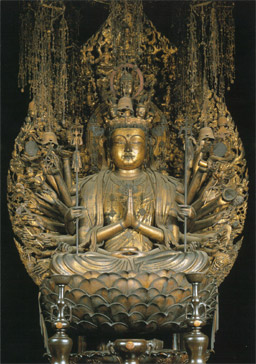
Before going to Kiyomizu-dera, we visited Sanjusangendo, which translates literally to the Thirty Three Gen Hall*. This temple was built in 1164, but the main hall was rebuilt in 1266 after it was damaged in a fire.
Inside this approximately 65-meter-long hallway, there are one thousand golden, armed Kannon (similar to Buddha) statues**. 124 of these statues are from the original temple, and the other 876 statues were rebuilt at the same time the hall was rebuilt. It is said that each of the statues has a different face so that you can find the face of the person you are praying for, but I couldn't see more than about five different faces in amongst the thousand statues.
In the temple you weren't allowed to take any pictures of the sacred statues, but there still seem to be pictures floating around of the statues.

A picture can only convey so much. Inside this temple there is a spooky feeling hanging in the air. I can't describe it, except that it made the air feel really heavy. I felt like if I wasn't careful, I would wake up something powerful and terrifying that had been asleep for hundreds of years. With all of the statues in the hall, and even though they all had their eyes closed, it feel like something was watching you as you walked down the hall. It was extremely unsettling, but at the same time really really cool. In addition to the one thousand armed Kannon in the temple there is one large Kannon in the canter of it all. At one point it must have been golden, but now it is fading and dusty and worn, but that just makes it all the more enthralling.

In front of the ranks of Kannon are 28 guardian deities, the most famous and important being the statues of the thunder god Raijin and the wind god Fujin. Not only are the Kannon a National Treasure, but each of the 28 statues of the guardian deities is a National Treasure.
I could have stayed in that hall all day, but no on else seem as fascinated by it as I was, so we left for Kiyomizu-dera before I even had time to read all of the signs about the guardian deities. But I got an omamori that's supposed to make me have better luck, something I am greatly lacking.

After a day full of sightseeing and building up my good luck we went out to eat dinner at a Japanese-Italian fusion type restaurant. I decided to be adventurous, and I unknowingly ordered pasta with fish eggs on it. It turns out that fish eggs don't actually taste like much, and now I can say I've eaten fish eggs.

After dinner we checked into a ryokan, a Japanese inn. Two rooms were reserved, one Western-style room and one Japanese room. Adena, the other YFU student I was traveling with, and I were in the Western-style room. I wanted the Japanese room, but I figured that since Haruka and Hiromi has just taken us around Kyoto, I was going to do whatever they told me too because they had done so much for us. Luckily for me, Haruka decided that since they were in charge of us, we should split up with one adult to a room and one YFU kid. It appears that my good luck charm is working already.

The hotel room was adorable, complete with tatami mats, futons with amazingly fluffy bedding, yukata (way better that the Tokyo Disney Yukata), and a low-to-the-ground table with chairs that made your feet fall asleep.
Hiromi was adorable too. While watching the Wimbledon women's finals, she commented the Zvonareva was really pretty. After that I pointed out Zvonareva's coach, and for the next thirty minutes she waited for him to appear on screen again so that she could take a picture of him with her phone. There's a reason he modeled in Italy. After watching Zvonareva lose, we watched a Japanese girl lose too and decided it was time for bed.


*A ken is an ancient Japanese measurement. There is no specific length of a ken. Instead, it refers to the space between the columns of a temple.

**The statues are made of Japanese cypress and painted golden.