Showing posts with label travel. Show all posts

Wednesday, July 21, 2010

Farewell, Nagoya

Never have the stained gutters in Tokaidori Station looked so pretty, nor have the buildings outside the station with rusting windows, peeling paint, and yellowing signs looked so friendly. Sleeping right now is out of the question, since my last few hours in this house would pass without me even noticing it. Even the obnoxious thing outside my window is a little quieter tonight.

Tonight we went out to eat okonomiyaki where you actually grill it yourself. Knowing my host mother I assumed that she would brig a present, so I brought my present too. Sure enough, she pulls out a bag full of a pair of gorgeous chopsticks in a cute little carrying case, a card that everyone signed, and a picture CD, Stitch mug, and Stitch memo pad from my host sister.
So, I pulled out my photo album. My host mom was the only one who had actually seen the pictures at all, but I added a few more photos in at the end of me and my host family. It was all very fun, talking and exchanging presents and stuff, until I read the letters inside the card; especially the one my host sister wrote in English. I almost cried. Tomorrow is going to be bad, I can tell.

Things I will miss (in no particular order):
Japanese food
subways and trains
my host fathers weird habit of bringing bugs home
speaking Japanese well
my fluffy comforter
the ¥100 shop down the street
running in the park and seeing cute old people playing croquet
vending machines
breakfast (cereal, fruit, yogurt, some various bread or pastry, coffee, and a Japanese newspaper covered in Kanji)
my host dad's dorky hats
cute Japanese guys
the cleanliness of construction
my host family (of course)
sitting down at the table for dinner
being able to recycle absolutely everything
Mr. Donut
matcha flavored things

Things I am looking forward to (in no particular order):
speaking English
seeing my friends and family
cuddling with my pets
Mexican food
wearing short shorts and tank tops
being barefoot
public trash cans
being able to use a fork and spoon
being able to snack whenever I want
climbing
lotion that isn't weird Japanese lotion
showering whenever I want
not being that tallest person in a crowded room or subway
not being stared at when people walk past
seeing the Austin skyline as I drive home from the airport

Very bittersweet.

I'll see everyone 'tomorrow.' I don't know if time is really going to exist for me for the next 24 or so hours. I am arriving in San Francisco in the 22nd earlier than I left Tokyo on the 22nd, and I'm arriving in Austin 6 hours after I left Tokyo. Tomorrow is going to be the longest day of my life. Literally.

Tuesday, July 6, 2010

Kyoto, Revisited

The second day we were in Kyoto we had a leisurely morning; no early trains or hauling luggage around. We woke up and watched a replay of the Spain-Paraguay match while we ate our breakfast in a cute little dining room with another exchange student and her visiting family. They were from Boston and she had just finished a seven month home stay with another program, and it turned out the her and Adena have several mutual friends. Small world.
This was also the first, and last, morning that I ate a Japanese breakfast. I cannot handle fish, miso, some odd substance that looked like tofu but tasted fishier than tofu, before about noon. Also, I can't operate a pair of chopsticks that early in the day. Now that I've tried it I am justified in saying that I prefer Western-style breakfast. I have great respect for those people who can consume fermented soybean soup with two thin, wooden sticks for breakfast, but I will stick to cereal and fruit with a spoon and fork. Please and thank you.

After breakfast we boarded a train bound for Arashiyama, (which means storm mountain, but which is also just the mountain's name), and I was a little disappointed when I got there. I was expecting a rugged mountain worthy of the name Arashiyama, with deep gorges that had taken peoples' lives and untamed, foreboding forests. Instead, it was a sleepy town full of souvenir shops with a pretty river running through it and mountains surrounding it.

Me Adena, and Haruka sitting by the river, glistening with sweat from the walk from the station. Also take note of the gangsta peace sign.
I don't mean to say that it wasn't a nice town, because it was. It smelled good and had a uniquely Japanese feel about it, but I expected to see more 'Danger: Cliff' signs and fewer signs outlawing business transactions.

Little did I know that there was more to come. After souvenir shopping for a little bit and basking in air conditioning, we stumbled upon (I think it was planned and I was just unaware) a busy path winding up into the forest and up the mountain. This is more what I thought Arashiyama would be like.
I think this is a graveyard, but there's no real reasoning behind that assumption. A graveyard is a lot cooler than anything else that this would be, so I'm just hoping.
The path wound its way through a bamboo forest the whole way up the mountain. The backyard bamboo we have in Texas can barely be called bamboo in comparison to this forest. The biggest bamboo were probably six inches in diameter, give or take a little, and the smallest were about the size of my neck. There was no end to the forest in sight on either side of the path, and practically no sky peeked out from between the glowing green canopy of bamboo.
There were gift shops and temples and shrines nestled here and there in the bamboo, and we stopped by one of each.
The shrine we saw was right next to a little pond where the wind was blowing everything everywhere.
In this picture you can see the torii, the little gate things with the ropes on them, and in the background you can see the bell that people ring to get the attention of the gods before they clap their hands twice and pray. The wooden plaques hanging up are called ema. You can buy these plaques at a shrine, write your wish on it, and hang it up with all of the others and your wish will be granted.
Here there is a guardian (I think) and the place where you wash your hands and mouth to purify yourself before you pray at the shrine. Most of the shrines I've been to have had lost of ladles and huge basins where you can wash your hands (first left, then right) and mouth (after your hands), but this one was tiny.

After that we stopped at a gift shop and waited for a sightseeing train to arrive. I was imagining a dinky little train like the one in Zilker Park, but this was a legitimate train. It was called the Sagano Romantic Train, but most of the passengers were parents with children and other tourists. It was not what would call 'romantic.' The view from the train was amazing though. I felt like I had gone through a time warp (and a reality warp) and ended up in Middle Earth...
...except for the huge telephone/electricity line in the background.
I had seen Tanuki here and there in front of shops and restaurants, but never before have I seen so many terrifying Japanese raccoon dogs in one place, or so neatly organized.

The Japanese is both a real creature, and a mischievous and wily character in Japanese folklore. The really creepy statues are usually wearing these hats, carrying a bottle of sake in one hand, and a promissory note or empty purse in the other in the other, and they always have huge stomachs and 'humorously large' testicles based on biological fact. Why would you want one of these things in front of your shop?
Luckily, there was more scenery to wash that image out of my head.

I think the picture is too small, but in the bottom corner there are two people kayaking those rapids. I realized later why there were so many kayakers. In the middle of tens of rice paddies, there was a place that rented out kayaks and had little kayak outings.


I was more focused on the rice paddies. They're so cool! On the way back to the station we ran into an enormous tanabata decoration. There were bamboo archways on either end and the sides were lined with bamboo weighed down with countless strips of paper.


Tanabata is a festival on July 7th (7/7), and the story behind it is that this is he only day that a prince and a princess can meet because of something to do with the milky way.
We visited a museum too, but it wasn't very exciting. I say several of Van Gogh's original 'Water Lilies' but we were rushed for time so I wasn't able to properly admire them.
The train ride back to Nagoya on the shinkansen was about 35 minutes, compared to the two hours it took us on a regular train. Why are the Japanese so great at inventing stuff, and why do we not get any of their technology?

Saturday, July 3, 2010

Kyoto day 1

Thank you, General Douglas MacArthur and Secretary of War Henry Lewis Stimson. Were it not for them, Kyoto and its 1600 Buddhist temples, 400 Shinto shrines, and its 14 "Historic Monuments of Ancient Kyoto" that have been designated a UNESCO World Heritage site would have been destroyed in a fashion similar to that of Hiroshima or Nagasaki.
Hiroshima before and after Little Boy was dropped on the city.

If I ever meet any relatives of those men, I will hug them. Kyoto is an amazing city. After arriving in Kyoto Station after about two hours on a regular train, our itinerary was as follows:
Day 1:
Sanjusangendo (三十三間堂/さんじゅうさんげんどう) 33 Gen Hall
Kiyomizu-dera (清水寺/きよみずでら) Kiyomizu Temple
Kinkakuji (金閣寺/きんかくじ) Temple of the Golden Pavilion
Instead of presenting things in chronological order, I'm going to save the best for last.
I, Adena (a fellow YFU student), Haruka (Adena's host sister who is out of college), and Haruka's friend Hiromi, had a busy day ahead of us.

By the time we got to Kinkakuji after about thirty minutes on a bus, we had only ten minutes until the temple closed and it was pouring down rain. Since the weather was so horrible and we were running so low on time there weren't many other visitors there to get in the way. Needless to say, the temple was very golden.

Compared to the other temples I have been to, in both Nagoya and Kyoto, it didn't really feel much like a temple. In fact, it was originally built as a retirement villa for Shogun Ashikaga Yoshimitsu in the late 1300s and converted into a temple by his son, Shogun Ashikaga Yoshimochi.
Later, in 1950, the original temple was burned down when a monk named Hayashi Yoken attempted suicide. The temple was rebuilt in 195, and in 1984 the lacquer on the Temple was found to be decaying. In 1987 the new coats of thicker and more robust paint and gold leaf were completed.
On the top you can see the phoenix roof ornament. I don't think there's any significance, I think it's just a phoenix on the roof.
A few statues that I think are Jizo, the protectors of travelers and children.
The temple was beautiful, but it did not have the same feeling about it that the other temples possessed. Maybe it was because the latest renovation, a new roof, was completed in 2003, or maybe it was because you couldn't actually enter the temple, but it felt more like an artwork being displayed than a temple. It was an extremely beautiful piece of art though.

Before going to Kinkakuji, we spent most of our day at Kiyomizu-dera. Kiyomizu-dera is a Buddhist temple that dates back to 798, but the current structures were built in a reconstruction effort in 1633. Not one nail was used to build the temple complex, and the name kiyomizu, meaning clear or pure water, comes from the waterfall that runs off in the nearby hills. The three tiered pagoda at Kiyomizu-dera.
The waterfall runs out of the mountains into this little fountain, where people wait in line to drink from the spouts.
There are three spouts, and there are sanitized cups with which you can reach out and drink for health, longevity or wisdom. Traditionally, you should only drink from tw of the waterfalls because if you are greedy and drink from all three it will bring misfortune upon you. I only drank from one, and I think it was the health waterfall, but I'm not sure. I'm okay with longevity or wisdom, too.
Fun fact about Kiyomizu-dera: There is a phrase "to jump off the stage at Kiyomizu." This phrase refers to an Edo Period tradition of jumping the 13 meters off of the stage at Kiyomizu-dera, and if you survived the jump your wishes would be granted. Out of 235, 85.4% of the jumps were "successful," meaning the jumper didn't die. Injuries are another matter. Now, jumping off the stage at Kiyomizu is strictly forbidden.
On the right you can see just how big a fall it would be, and in the middle you can see Kyoto on the horizon and Kyoto Tower sticking up out of the city.

Behind the main hall of Kiyomizu are several other shrines, but the most popular and famous of them all is Jishu Shrine, dedicated to the god of love and 'good matches.' There were all sorts of love omamori for sale and omikuji for sale. Omikuji are little sheets of paper that usually cause one or two hundred yen. There are various fortunes you can get, ranging from the best, more good than bad, the worst, and everywhere in between. Inside the omikuji are various and more specific fortunes pertaining to love, money, lawsuits, lost items, etc., all based on the overall luck of the omikuji. When you get a bad fortune you can tie it to a post and the bad luck will leave you. Hiromi tying up her bad-luck omikuji.
Omikuji are at every shrine that I have been to, but these stones are unique to Jishu Shrine.

If you walk safely between them with your eyes closed, you will find your true love. You can have someone help you, but that means that you will have to have a go between to find your true love. Both Adena and I made the journey successfully! But... we both helped each other out. They need to include that part on the sign explaining the meaning of the stones.

Before going to Kiyomizu-dera, we visited Sanjusangendo, which translates literally to the Thirty Three Gen Hall*. This temple was built in 1164, but the main hall was rebuilt in 1266 after it was damaged in a fire.
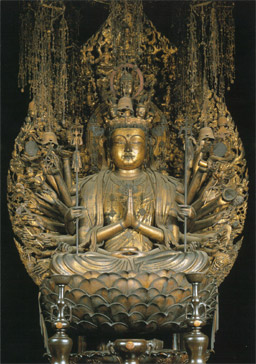
Inside this approximately 65-meter-long hallway, there are one thousand golden, armed Kannon (similar to Buddha) statues**. 124 of these statues are from the original temple, and the other 876 statues were rebuilt at the same time the hall was rebuilt. It is said that each of the statues has a different face so that you can find the face of the person you are praying for, but I couldn't see more than about five different faces in amongst the thousand statues.
In the temple you weren't allowed to take any pictures of the sacred statues, but there still seem to be pictures floating around of the statues.

A picture can only convey so much. Inside this temple there is a spooky feeling hanging in the air. I can't describe it, except that it made the air feel really heavy. I felt like if I wasn't careful, I would wake up something powerful and terrifying that had been asleep for hundreds of years. With all of the statues in the hall, and even though they all had their eyes closed, it feel like something was watching you as you walked down the hall. It was extremely unsettling, but at the same time really really cool. In addition to the one thousand armed Kannon in the temple there is one large Kannon in the canter of it all. At one point it must have been golden, but now it is fading and dusty and worn, but that just makes it all the more enthralling.

In front of the ranks of Kannon are 28 guardian deities, the most famous and important being the statues of the thunder god Raijin and the wind god Fujin. Not only are the Kannon a National Treasure, but each of the 28 statues of the guardian deities is a National Treasure.
I could have stayed in that hall all day, but no on else seem as fascinated by it as I was, so we left for Kiyomizu-dera before I even had time to read all of the signs about the guardian deities. But I got an omamori that's supposed to make me have better luck, something I am greatly lacking.

After a day full of sightseeing and building up my good luck we went out to eat dinner at a Japanese-Italian fusion type restaurant. I decided to be adventurous, and I unknowingly ordered pasta with fish eggs on it. It turns out that fish eggs don't actually taste like much, and now I can say I've eaten fish eggs.

After dinner we checked into a ryokan, a Japanese inn. Two rooms were reserved, one Western-style room and one Japanese room. Adena, the other YFU student I was traveling with, and I were in the Western-style room. I wanted the Japanese room, but I figured that since Haruka and Hiromi has just taken us around Kyoto, I was going to do whatever they told me too because they had done so much for us. Luckily for me, Haruka decided that since they were in charge of us, we should split up with one adult to a room and one YFU kid. It appears that my good luck charm is working already.

The hotel room was adorable, complete with tatami mats, futons with amazingly fluffy bedding, yukata (way better that the Tokyo Disney Yukata), and a low-to-the-ground table with chairs that made your feet fall asleep.
Hiromi was adorable too. While watching the Wimbledon women's finals, she commented the Zvonareva was really pretty. After that I pointed out Zvonareva's coach, and for the next thirty minutes she waited for him to appear on screen again so that she could take a picture of him with her phone. There's a reason he modeled in Italy. After watching Zvonareva lose, we watched a Japanese girl lose too and decided it was time for bed.


*A ken is an ancient Japanese measurement. There is no specific length of a ken. Instead, it refers to the space between the columns of a temple.

**The statues are made of Japanese cypress and painted golden.

Saturday, June 26, 2010

Toyko Disney Part I: Disneyland

\Usually when I think about travel I get stressed out and wait for my dad to get bossy and put everyone else in a bad mood too. But then again, I usually don't travel by bullet train. My host mom and I left the house at 7:45 and were on a train to Nagoya Station one car ride and one subway wicket later. There is no security to go through, no boarding group hassle, no fighting over who sits where or who has to drive, and the seats are amazingly roomy.
The Shinkansen (bullet train) travels at an average speed of 186 miles per hour (300 km/h), and it was built in 1964. You may wonder why after 40 years we don't have something like this in the United States, and I wonder that too. To give you an idea of how fast 186 miles per hours is, I took a little video on the train.

The scenery was pretty crazy too. It would move seamlessly from rice paddies to city and back in about thirty seconds. You can also see Mount Fuji on days when it isn't cloudy.
Approximately 1 hour and 45 minutes after leaving Nagoya Station, my host mom and I arrived 225 miles away at Tokyo Station. My host sister was waiting for us at the Tokyo Disney subway station with fancy Fast Pass tickets that she got because she's an employee*, where we were greeted by "Be Our Guest." I could tell it was going to be fun.


Disney Land was the first stop on our list. We arrived just in time for the morning Easter Wonderland parade (Easter in June?).

First came roller skating rabbits:

I just missed catching their cute little trick on video.

After the rabbits there were various Disney characters;

Alice, the Mad Hatter, and the Cheshire Cat;


These cute bunnies;


Pooh and crew;


Stitch, pink Stitch, and Lilo;


This guy;


Woody, Buzz Lightyear, Mike, and Sully;

and various other characters that I didn't feel needed to be mentioned. Mainly Goofy, Pluto, Mickey, Minnie, and Chip and Dale. No important characters.

After the parade it started pouring rain so we rushed to get Fast Passes for Space Mountain and then watched a nearby show while we waited for our Fast Pass time to be up. The show was called 'One Man's Dream,' and while I didn't catch any of the Japanese they were singing, Disney says "this live stage show recreates the memorable moments of the Disney animated films and cartoons. Opening with the jump from black and white to color, the show also features such scenes as Peter Pan soaring above the stage and the circus from A Bug’s Life." Regardless of whether or not you understand the plot, it's visually appealing as well.
When the show finished it was time for Space Mountain and I had no idea what to expect. I was thinking there would be Disney characters and black lights (which Disney LOVES, and also which make my plastic nose stud retainer glow) but I was very wrong. The ride is pitch black, and then neon lights that looks like lightning shoot past you and up to where the first ascent ends. When you reach the top of the hill, you can't see anything except for projected stars everywhere. You can't see the track, the person next to you, or even your hands in front of you. It was awesome.
Of the three 'jet coasters,' Space Mountain was by far the best. If Space Mountain as a jet coaster, as the Japanese call it, then Splash Mountain and Big Thunder Mountain were more like glider coasters. Splash Mountain would have been better had I not built it up in my mind as the scariest ride EVER after my traumatic childhood experience with it.
After riding several roller coasters, shooting aliens with Buzz Lightyear, hunting for honey with Winnie the Pooh (fun ride), canoeing, taking a jungle tour and a Western tour within about twenty feet of each other, and eating two meals that left me full and happy, the fun wasn't over. Tokyo Disney Land has a night parade where the floats are lit up with hundreds, if not thousands, of Christmas lights. This was possibly my favorite parade.
The Cheshire Cat again


A crazy caterpillar (and the guy who kept getting in the way of my pictures)


Some swirly snails


Snow White ( didn't get very good pictures of the dwarfs)


Peter Pan and Wendy


Pete and his dragon


Pooh and crew again with some bumblebees following Pooh's honey


Buzz Lightyear, on his own this time (followed by Woody and the girl cowboy, but my pictures suck)


Nemo! (followed by Crush and his pals)


Lumiere and Mrs. Potts (followed by Belle and the Beast, but their float wasn't very impressive)


Mike, Sully and of course Boo


Cinderella and her prince, but their floats didn't photograph well


I'm worried some kid may have a seizure


Lilo and Stitch's float


And finally, no Disney parade is complete without a little commercialism.

After the parade Kanako (my host sister) and I rode Space Mountain one more time since there was barely any line at all and sadly, it wasn't as fun the second time as it was the first time. After that, I was too tired to remember much. We got on a bus and went to the hotel.

A quick word about hotels in Japan. In hotels, they always have toothbrushes and shampoo and all of those things that seem to be just for show but that no one seems to use. In Japan, they use them. My host mom told me before I left that I didn't need to bring a brush, a toothbrush, toothpaste, face wash, or a towel because they would all be at the hotel. Not only that, but they had yukatas (hot and not well-fitted yukatas) at the hotel as pajamas. While I went along with everything my host mom and sister told me to, I will be bringing my own toiletries next time a visit a hotel, no matter the country. If I'm staying in a hotel, I at least want to have my own soap and toothbrush to make me feel a little more at home.

Stayed tuned for Part II: Disney Sea

*My host sister doesn't dress up like a princess, she manages a restaurant at Tokyo Disneyland. It's more respectable, but it's less fun.